
Ottawa National Forest

Ottawa National Forest | Over One Million Acres
The almost one million acres of the Ottawa National Forest are located in the western Upper Peninsula of Michigan. The forest extends from the south shore of Lake Superior to the Wisconsin border. The area is rich in wildlife viewing opportunities; breathtaking views of rolling hills dotted with lakes, rivers and waterfalls; and spectacular fall colors. But you have to see it to believe it–come visit the Ottawa!
Explore the Ottawa National Forest
Black River Harbor
Part of the Black River National Scenic By-way, Black River Harbor is a federally run harbor and park with access to beaches, hiking trails, rivers and the best series of waterfalls in the entire Upper Peninsula of Michigan.
Black River Waterfalls
The Black River Waterfalls within the Black River canyon are a series of 5 cascading waterfalls that flow directly into Lake Superior. The waterfalls are considered the best in the Upper Peninsula and are a truly unique backcountry adventure.
Porcupine Mountains Wilderness State Park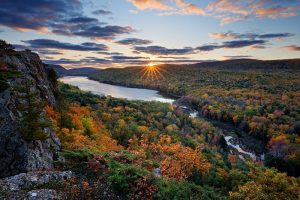
Though not technically in the forest, the Porkies are directly connected to the Ottawa and share a contiguous boundary.
At roughly 60,000 acres, Porcupine Mountains Wilderness State Park is Michigan’s largest state park and one of the few remaining large wilderness areas in the Midwest. It’s home to a 35,000-acre old-growth forest, roaring waterfalls, miles of rivers and streams, more than 90 miles of hiking trails, a modern and rustic campground, backcountry camping, the Lake Superior shoreline and unrivaled vistas. Great Lakes beach safety.
The park boasts many popular natural attractions, including Lake of the Clouds (with an accessible viewing area), the scenic Presque Isle River corridor. Other attractions include the Summit Peak observation tower, Porcupine Mountains Ski Area, an 18-hole disc golf course and much more.
Sylvania Wilderness
The Sylvania Wilderness encompasses 18,327 acres of primitive lands and is part of the National Wilderness Preservation System.
Visitors can camp in 50 designated campsites within the Sylvania Wilderness. Visitors enjoy endless canoeing, fishing, hiking and wildlife viewing opportunities.
Natural Features: The old-growth forests and pristine lakes in the region provide habitat for a wide range of animal and plant life, including rare orchids, bald eagles, loons and osprey. The wilderness contains 34 named lakes, some with sandy beaches and others surrounded by record-size red and white pines.
The Ottawa National Forest is comprised of nearly 1 million acres and is located in the western reaches of Michigan’s Upper Peninsula. The forest’s rolling, forest covered hills extend from the south shore of Lake Superior to the Wisconsin border. Lakes, rivers and waterfalls are found throughout this beautiful landscape.
Recreation: Sylvania’s abundant lakes provide plentiful non-motorized boating, canoeing, kayaking and fishing opportunities. Other popular activities include hiking and viewing wildlife.
Facilities: Sylvania Wilderness Backcountry Camp is not a physical campground located at one location. The 50 individual sites are located along eight lakes within the Sylvania Wilderness. Camping is allowed only at designated sites. Campsites are primitive, but each is equipped with a campfire ring and a wilderness latrine.
Camping is permitted at designated sites by permit only. Permits MUST be reserved by visiting Recreation.gov (see details below). No first-come, first-serve walk in sites available in 2020.
Fish Your National Forests: Fish available include: Trout, Native Trout, Bass, Walleye, Panfish, Pike; Types of fishing available include: Wade, Shore, Non-motorized boat, Float tube, Fly, Spin, Ice;
Maps:
Lake Gogebic
Lake Gogebic, Michigan’s largest inland lake, lies at the far western end of the Upper Peninsula. With abundant opportunities for fishing, hiking, hunting, camping, and winter sports, Lake Gogebic is a four-season vacation gem that – for all its attractions – retains the peaceful atmosphere of a small Northwoods community, untroubled by traffic and crowds.
Lake Gogebic’s 13,380 acres of prime fishing water teem with walleye, smallmouth bass, northern pike, jumbo perch and whitefish, providing both catches for the novice and challenges for the veteran angler. The surrounding forests offer prime hunting for deer, bear, small game and birds.
Families, couples, and outdoor sports enthusiasts will enjoy Lake Gogebic’s summer hot spots for water sports, camping, sightseeing and hiking the surrounding timberland. The area is full of historic sites and natural beauty. Wildflowers and wildlife are everywhere in spring and summer, the autumn colors are spectacular, and winters are as white and still as one can only imagine. Waterfalls abound – with some hidden deep in the woods, and others easily accessible from town.
Sturgeon River Gorge Wilderness Area
The Wild and Scenic Sturgeon River rushes out of the northern portion of this wilderness, over the 20 foot volcanic outcroppings of Sturgeon Falls, and through a gorge that reaches 350 feet in depth and a mile in width. Throughout this rugged, steep Wilderness, the Sturgeon and Little Silver Rivers and their tributaries have carved falls, rapids, ponds, oxbows, and terraces. Stunning views are possible from the eastern rim of the gorge. Except for a few naturally bare slopes, most of the land is forested with pine, hemlock, aspen, sugar maple, birch, and basswood. When the leaves of the hardwoods change color in the fall, they form a vivid tapestry. There are few established trails in Sturgeon River Gorge Wilderness, and the few overgrown logging roads are hard to find and follow. The North Country National Scenic Trail parallels the northern and eastern boundaries for about eight miles. Sturgeon River Campground offers seven sites on the southeastern boundary. In spring and during peak runoff, kayaking and white water canoeing are challenging, and only recommended for advanced paddlers.
North Country Trail
The North Country National Scenic Trail is the longest in the National Trails System, stretching 4,800 miles across eight states from North Dakota to Vermont, traversing forests and farmlands, remote terrain and nearby communities. Whether you’re looking to day-hike a few miles or plan a longer overnight backpacking trip, a multitude of diverse landscapes and hiking opportunities are waiting for you.